Keep Out of Reach of Children
WARNING: For adult use only. Not a toy. Keep out of reach of children.
Government Documentation
Small Parts Requirements — CPSC Staff Summary
(PDF · 2 pages · March 2023)
Small Parts Ban and Choking Hazard Labeling – Overview
(Webpage)
Small Parts and Choking Hazard Labeling – FAQs
(Webpage)
Handbook for Manufacturing Safer Consumer Products
(PDF · 49 pages · July 2006; general manufacturing guidance)
Reference Dimensions
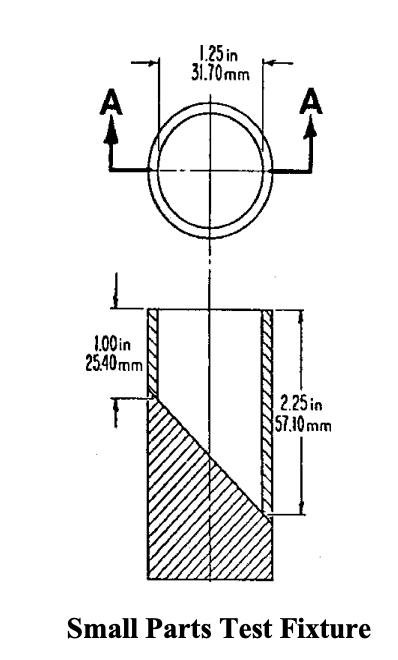
Source: CPSC staff’s March 2023 summary of 16 C.F.R. Part 1501. Consult the current regulation for controlling requirements.
CAD Dimensions
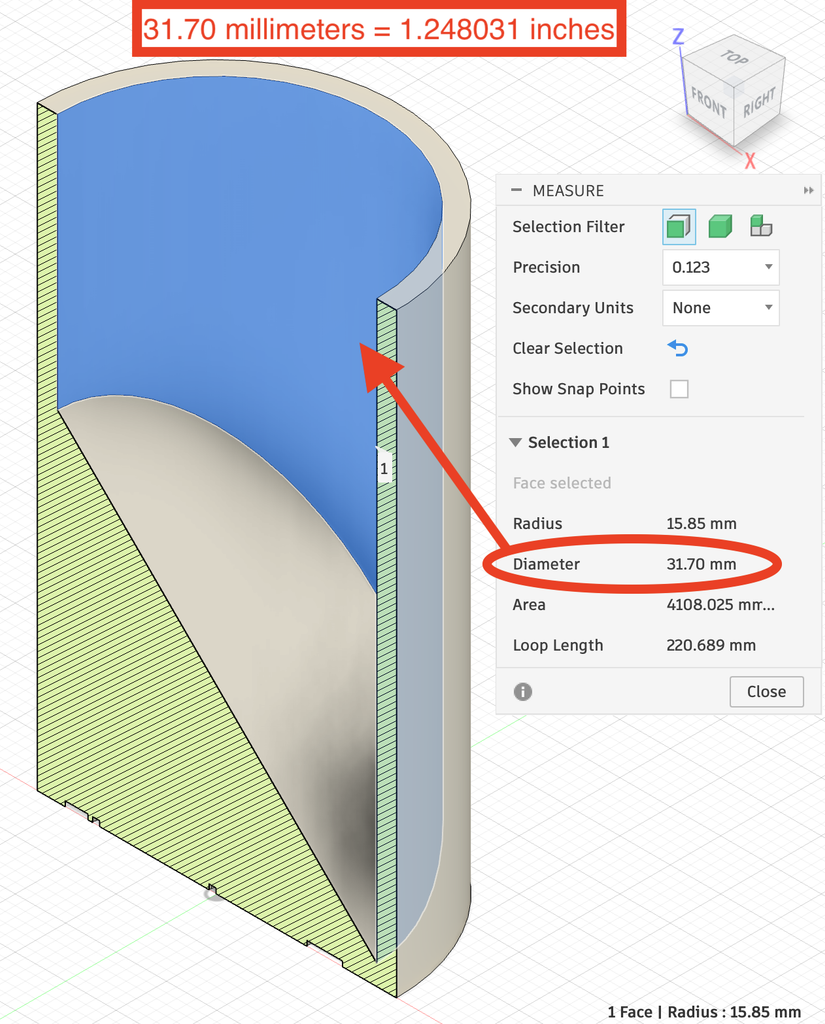
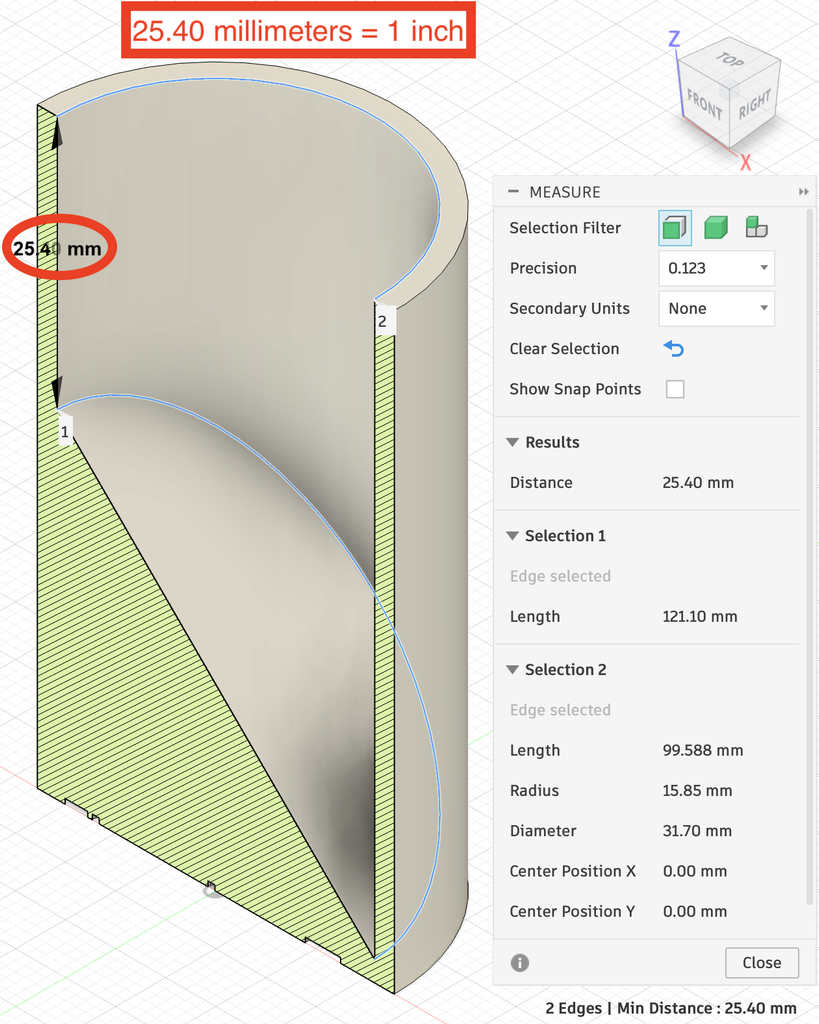
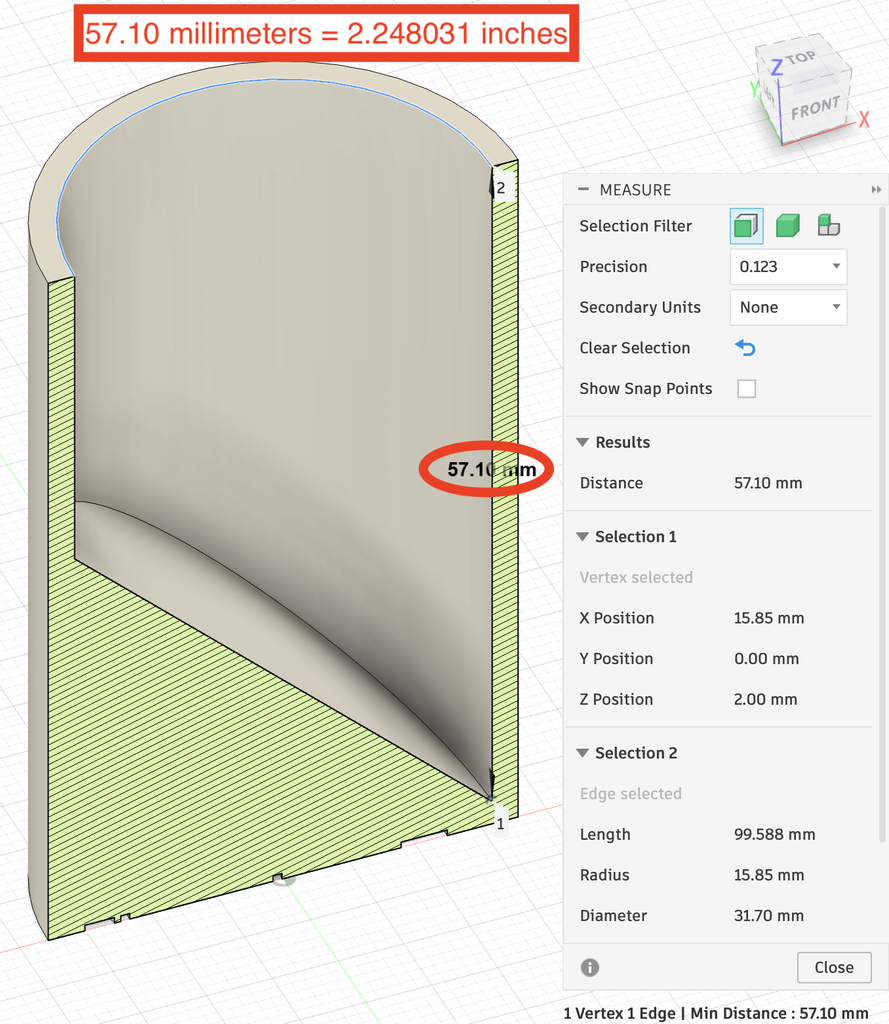
Source: CAD screenshots of the Niko Mango CPSC Choking Tube design, with red annotations added.
Source of Dimensional Variability
- Unit conversion. The CAD model shown here uses an internal diameter of 31.70 mm, a minimum internal depth of 25.40 mm, and a maximum internal depth of 57.10 mm. Under 16 C.F.R. § 1501.4(a), the inch dimensions control for compliance. Their exact metric equivalents are 31.75 mm, 25.40 mm, and 57.15 mm, respectively; the metric values printed in the CPSC summary are approximations.
- Manufacturing variation. Finished dimensions can differ from the CAD model. The dimensional variation of this product has not been established by the information provided on this page.
- Estimated dimensional variation. Estimated deviations are 0.1–0.3 mm in internal diameter and 0.1–0.2 mm in maximum internal depth. These estimates are not verified acceptance limits for each finished unit.
Limitations and Safety
Use this small-parts test cylinder for preliminary size screening. A cylinder check alone does not establish product safety, regulatory compliance, age suitability, or warning-label requirements.
Check whether the object fits entirely inside the cylinder in any orientation, without compressing it. An object that does not fit can still present a choking or other safety hazard.
For covered products intended for children under 3, applicable use-and-abuse testing and testing of detached pieces are also required. Prohibited small parts cannot be made acceptable by adding a warning. Subject to applicable exceptions, toys and games intended for children ages 3 to under 6 that contain small parts require the warning specified in 16 C.F.R. § 1500.19. Balloons, small balls, and marbles have separate requirements.
Treat a borderline result as inconclusive. Obtain qualified testing advice before making a compliance claim, selecting warning labels, or releasing the product.
Manufacturing variation can affect the cylinder’s dimensions. Verify the finished cylinder’s dimensions and the test result when an object is near the size limit.
Use Caution
Use a CPSC Choking Tube as a starting point to determine if objects meet the strict criteria for choking warning requirements.
Even if an object still passes the CPSC Choking Tube test, the object can still get lodged in a child’s airway and cause injury or death. Objects larger than the CPSC Choking Tube size are not automatically immune to child safety considerations.
If an object is “close” or “barely” or “almost”, consider explaining this to a federal officer or someone looking to sue you because their child died before redesigning the product or deciding on warning labeling.
If a product barely passes, remain on the side of caution and issue the legally required choking warning and/or redesign the product to be physically larger.
All attempts have been made to have the tightest manufacturing tolerances for the Niko Mango CPSC Choking Tube, but natural variation exists in all manufacturing. If an object is close enough to the limit that you are considering tiny factors like plastic shrinkage at various room temperatures, that object is too close and should not pass the CPSC Choking Tube test.